

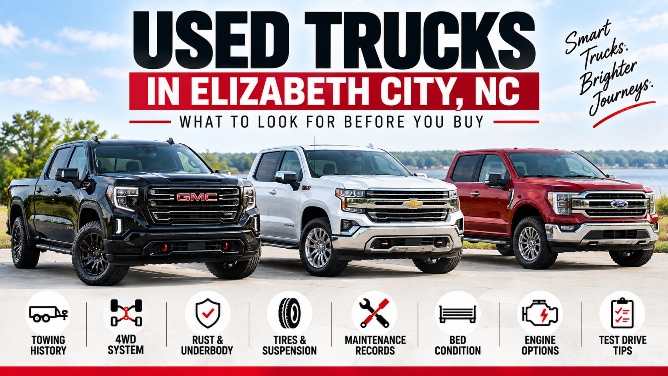
Buying a used truck is a little different from buying a used car.
A pickup may have spent its life driving back and forth to work. It may have pulled a boat every weekend. It could have hauled equipment, traveled off-road, worked on a farm, or spent years doing nothing more demanding than making grocery runs.
Two trucks with the same mileage can have completely different histories.
That's why finding the right used truck isn't just about choosing the lowest mileage or the lowest price.
If you're shopping for a used truck in Elizabeth City, northeastern North Carolina, or the surrounding area, here are some of the things we'd look at before making a decision.
Start With What You Actually Need the Truck to Do
Before comparing trucks, figure out what you're asking the truck to do.
This sounds obvious, but it's easy to get distracted by a bigger engine, larger tires, a higher trim level, or a good-looking truck and forget about how you're actually going to use it.
Ask yourself:
- Will I tow a boat, camper, trailer, or equipment?
- How much weight do I need to tow?
- Will I regularly carry cargo in the bed?
- Do I need four-wheel drive?
- Will this be my daily driver?
- How many passengers will I normally carry?
- Do I need a Crew Cab?
- Do I want a short bed or a longer bed?
- How much do fuel costs matter to me?
- Do I really need a heavy-duty truck?
Buying more truck than you need can mean spending more on the truck itself, fuel, tires, and maintenance.
Buying too little truck can be an even bigger problem if you later discover it doesn't have the payload or towing capability you need.
Start with the job. Then find the truck.
Try to Understand How the Used Truck Was Previously Used
Mileage tells you how far a truck has traveled.
It doesn't tell you what happened during those miles.
A 70,000-mile truck that spent years pulling heavy trailers may have experienced a different kind of use than a 100,000-mile truck that mostly traveled on the highway.
You probably won't know every detail of a truck's previous life, but there are clues.
Look at the condition of the:
- Trailer hitch
- Bed
- Tailgate
- Interior
- Frame
- Suspension
- Tires
- Wheels
- Undercarriage
None of these things automatically tells you a truck was abused.
Trucks are designed to work.
The goal is simply to understand what you're buying.
Get Underneath the Truck
Don't judge a used pickup only by how shiny the paint looks.
Take a look underneath it.
This is particularly important with trucks because they can be exposed to mud, water, road salt, boat ramps, job sites, and off-road conditions.
Look for:
- Significant rust or corrosion
- Fluid leaks
- Damaged skid plates
- Bent or damaged components
- Evidence of previous repairs
- Excessive mud or debris packed into hard-to-reach areas
- Condition of the exhaust system
Some surface rust can be normal, particularly as a vehicle gets older.
Heavy corrosion is different.
If something underneath the truck concerns you, have it inspected rather than guessing.
Why Rust Deserves Extra Attention Around Our Area
Living near the coast makes underbody condition worth paying attention to.
Elizabeth City isn't sitting directly on the ocean, but many vehicles in our region travel regularly toward the Outer Banks, Currituck, coastal Virginia, boat ramps, marinas, and other areas where they can encounter salt, sand, moisture, and brackish water.
That doesn't mean a coastal truck is automatically rusty.
It means the undercarriage deserves a look.
If you're considering a truck that has been used to launch a boat, look closely at the rear portion of the frame, hitch, suspension components, brake components, and other exposed metal.
If It's a 4x4, Make Sure the Four-Wheel-Drive System Works
Seeing a 4x4 badge on the side of the truck isn't enough.
Test the system.
The exact procedure depends on the truck, so follow the manufacturer's instructions.
Make sure the truck properly engages the available four-wheel-drive modes and pay attention to warning messages or unusual noises.
Also remember that four-wheel drive adds components to the vehicle.
Depending on the truck, that may include a transfer case, front differential, additional driveshafts, actuators, and other hardware.
Those components are another reason maintenance history and current condition matter.
Look for Signs the Truck Has Been Used for Towing
A truck being used for towing isn't automatically a negative.
That's one of the main reasons people buy trucks.
But you should still inspect the towing equipment.
Look at the:
- Receiver hitch
- Trailer wiring connector
- Safety-chain attachment points
- Rear bumper
- Trailer brake controller, if equipped
If the hitch shows obvious signs of heavy use, ask questions.
More importantly, if you're planning to tow with the truck yourself, don't assume every truck of the same model can tow the same amount.
Towing capacity can vary significantly based on:
- Engine
- Transmission
- Drivetrain
- Axle ratio
- Cab configuration
- Bed configuration
- Equipment packages
- Payload
- Trailer equipment
Verify the capability of the exact truck you're considering.
Take a Good Look at the Truck Bed
The bed can tell you quite a bit.
Scratches and dents don't necessarily bother us on a used work truck. That's what a truck bed is for.
But major damage deserves a closer look.
Check the:
- Bed floor
- Bed sides
- Tailgate
- Bedliner
- Tie-down points
- Bed lighting
- Power outlets, if equipped
- Multi-function tailgate features, if equipped
Make sure the tailgate opens, closes, and latches correctly.
If the truck has a tonneau cover, inspect that too.
Don't Overlook the Tires
Tires can make a meaningful difference in the value of a used truck.
Replacing four quality truck tires isn't something most buyers want to do immediately after purchasing a vehicle.
Check:
- Tread depth
- Uneven wear
- Cracks or dry rot
- Tire age
- Whether all four tires match
- Correct tire size
Uneven tire wear can sometimes point to an alignment or suspension issue, although an inspection is needed to determine the actual cause.
What About Oversized Tires?
Larger aftermarket wheels and tires can make a truck look great.
But don't assume every modification improves the truck.
Check for rubbing, unusual wear, poor alignment, and whether the modifications appear to have been installed properly.
Pay Attention to the Suspension
Used trucks frequently have modifications.
You may encounter:
- Leveling kits
- Lift kits
- Aftermarket shocks
- Different wheels
- Oversized tires
- Airbags or helper springs for towing
Modifications aren't automatically bad.
But they should be inspected.
During the test drive, listen for clunks or rattles and pay attention to how the truck tracks down the road.
If the steering wheel is off-center or the truck consistently pulls to one side, find out why.
Gas or Diesel: Which Used Truck Makes More Sense?
This depends heavily on how you're going to use the truck.
Gas Trucks
For many buyers, a gas-powered pickup is the simpler choice.
If your truck will primarily be used for commuting, family transportation, occasional hauling, and lighter towing, a gas engine may provide everything you need.
Diesel Trucks
Diesel becomes particularly interesting for buyers who tow regularly or prefer the torque characteristics and efficiency available from certain diesel powertrains.
But buying a diesel simply because someone tells you "diesels last forever" isn't enough of a reason.
Modern diesel engines can have additional emissions equipment and maintenance requirements that buyers should understand.
If you're considering a used diesel, learn about the specific engine rather than making a decision based only on the word diesel.
The right answer depends on your driving habits, towing needs, budget, and the specific truck.
How Many Miles Is Too Many for a Used Truck?
There's no universal mileage number where a truck becomes a bad purchase.
We'd rather evaluate:
- Condition
- Maintenance history
- Age
- Previous use
- Engine and drivetrain
- Price
- Upcoming maintenance
A clean, properly maintained truck with 100,000 miles may be worth considering over a lower-mileage truck that has been neglected.
We covered this topic in more detail in our guide: Is a Used Car With 100,000 Miles Worth Buying?
The same basic principle applies to trucks.
Mileage matters, but it doesn't tell the entire story.
Check the Maintenance History
Maintenance becomes increasingly important as a truck gets older and accumulates miles.
Depending on the truck, you'll want to consider items such as:
- Engine oil changes
- Transmission service
- Differential fluids
- Transfer-case service on 4WD models
- Coolant
- Brake fluid
- Spark plugs on gas engines
- Fuel filters on applicable diesel engines
- Belts and hoses
- Battery
- Brakes
The maintenance schedule is different from one truck to another.
Check the manufacturer's recommendations for the exact year, model, engine, and drivetrain you're considering.
What Should You Check During a Used Truck Test Drive?
Don't make the test drive a five-minute lap around the parking lot if you can avoid it.
Drive the truck in conditions similar to how you'll actually use it.
Pay Attention to the Engine
Acceleration should feel consistent with the vehicle, and there shouldn't be unexplained warning lights or obvious abnormal noises.
Pay Attention to the Transmission
Notice how it shifts while accelerating and slowing down.
Also pay attention when moving between park, reverse, and drive.
Test the Brakes
The truck should stop predictably without unusual noises or excessive vibration.
Listen to the Suspension
Drive over normal bumps and uneven pavement and listen for unusual clunks, rattles, or squeaks.
Check the Steering
The truck should track properly without requiring constant steering correction.
Try the Technology
Test the equipment that matters to you:
- Backup camera
- Parking sensors
- Bluetooth
- Touchscreen
- Heated and ventilated seats
- Power seats
- Climate control
- Trailer camera systems
- Driver-assistance technology
Check the Interior Too
Truck buyers sometimes focus so heavily on the mechanical side that they forget they're going to spend most of their time sitting inside the truck.
Look at the:
- Driver's seat
- Steering wheel
- Pedals
- Carpet
- Headliner
- Rear seats
- Storage areas
- Dashboard
- Door panels
If you're buying a Crew Cab as a family vehicle, sit in the back seat.
Make sure the space actually works for your family rather than assuming every Crew Cab has the same amount of room.
Should You Buy a Used Half-Ton or Heavy-Duty Truck?
Bigger isn't automatically better.
A heavy-duty truck can offer significantly more capability, but that capability comes with tradeoffs.
A half-ton pickup may offer a more comfortable everyday driving experience for someone who doesn't need heavy-duty towing or payload capability.
Heavy-duty trucks make more sense when your work, trailer, camper, or equipment actually requires the additional capability.
Don't pay for capability you'll never use.
But don't underestimate your needs either.
If towing is one of the main reasons you're buying the truck, determine your actual trailer weight and requirements before choosing the truck.
Don't Compare Used Trucks Based on Price Alone
This is one of the easiest mistakes to make when shopping online.
You find two trucks that appear similar and one is $3,000 cheaper.
The cheaper truck must be the better deal, right?
Maybe.
But look closer.
Differences can include:
- Mileage
- Trim level
- Engine
- 2WD vs. 4WD
- Cab size
- Bed length
- Towing equipment
- Tires
- Vehicle condition
- Options and packages
- Maintenance needs
- Vehicle history
A truck that's cheaper upfront but immediately needs tires, brakes, and other maintenance may not actually be the better value.
Compare the whole truck, not just the number beside it.
What Should You Ask Before Buying a Used Truck?
You don't need to be a mechanic to ask good questions.
- Can I see the vehicle history report?
- Has the truck been inspected?
- Are there any known mechanical issues?
- How old are the tires?
- Does the four-wheel-drive system work properly?
- Are there any warning lights?
- Are all the major features working?
- Does it have a trailer brake controller?
- What engine and drivetrain does it have?
- What maintenance may be coming up?
- What is included in the advertised price?
Good used-truck shopping isn't about finding a vehicle with absolutely no wear.
It's about knowing what you're buying.
Financing a Used Truck
If you're planning to finance your truck, consider the entire transaction rather than focusing only on the monthly payment.
The vehicle price, down payment, trade value, loan amount, interest rate, term, taxes, fees, and any optional products can all affect the payment and total amount financed.
If you'd like to begin the process before visiting Elizabeth City GMC, you can apply for financing online .
Trading Your Current Vehicle for a Used Truck?
Knowing approximately what your current vehicle is worth can help you understand your overall budget before you start comparing trucks.
Trade value can depend on the vehicle's year, make, model, mileage, equipment, condition, history, and current market demand.
You can start from home using our Kelley Blue Book Instant Cash Offer .
Frequently Asked Questions About Buying a Used Truck
Is it okay to buy a used truck with 100,000 miles?
It can be. Mileage should be considered along with maintenance history, condition, previous use, age, drivetrain, and price. A well-maintained higher-mileage truck can sometimes be a better choice than a neglected lower-mileage truck.
What is the most important thing to check on a used truck?
There isn't one single item. We'd pay close attention to the engine, transmission, frame, underbody, suspension, tires, brakes, 4WD system when equipped, maintenance history, and overall condition.
Should I buy a 4x4 truck?
That depends on how you'll use it. Four-wheel drive can be valuable for certain job sites, off-road conditions, boat ramps, snow, mud, and other low-traction situations. If you don't need it, a two-wheel-drive truck may still meet your needs.
Should I buy a gas or diesel used truck?
Gas trucks can make sense for many everyday drivers and lighter-duty uses. Diesel trucks can be attractive for certain towing and high-mileage applications. The best choice depends on the specific truck, your driving habits, towing requirements, fuel considerations, and maintenance expectations.
Should I avoid a used truck that has towed?
Not automatically. Trucks are designed to tow when properly configured and operated within their limits. Previous towing is simply another part of the truck's history to consider along with maintenance and current condition.
Are lifted used trucks bad to buy?
Not necessarily. The quality of the parts and installation matters. Modified trucks should be inspected for alignment, suspension geometry, tire clearance, unusual wear, and the overall quality of the work.
Should I get a used truck inspected before buying?
If you want additional information about a truck's condition, especially an older, higher-mileage, or modified truck, a pre-purchase inspection by a qualified mechanic can be worthwhile.
Shopping for Used Trucks in Elizabeth City, NC?
Whether you're looking for a daily driver, work truck, family pickup, hunting truck, or something to pull the boat toward the Outer Banks, take your time and buy based on what you actually need.
Look beyond the paint.
Check underneath it.
Drive it.
Test the four-wheel drive if equipped.
Look at the tires.
Understand the maintenance history.
And make sure the truck's configuration matches the work you're asking it to do.
If you're still early in the shopping process, our other used-vehicle guides can help too:
- Where to Buy a Used Car in Elizabeth City, NC: What to Look for Before You Buy
- Is a Used Car With 100,000 Miles Worth Buying? A Used Car Buyer's Guide
Then take a look at the current selection of pre-owned trucks and other used vehicles available at Elizabeth City GMC.
Shop Used Trucks & Pre-Owned Vehicles
Categories:
Used Car Buying Guides