

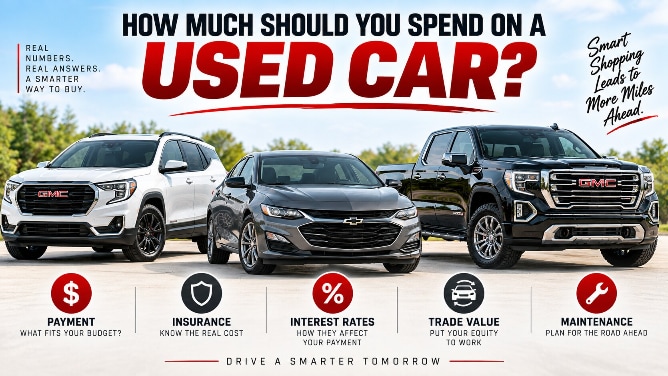
One of the first questions people ask when shopping for a used vehicle is also one of the hardest to answer:
How much should I actually spend on a used car?
You'll find plenty of rules online telling you to spend a certain percentage of your income or keep your payment below a specific number.
Those rules can be useful as a starting point, but buying a car isn't that simple.
Two people earning exactly the same amount of money can have completely different budgets. One might have a mortgage, student loans and childcare expenses. The other might have very little monthly debt.
Your credit, down payment, trade-in, insurance costs and how long you plan to keep the vehicle matter too.
Instead of starting with a random number, let's look at the expenses that actually determine what a used vehicle will cost you.
Start With Your Real Monthly Budget
Before looking at vehicles, look at your monthly finances.
Not the budget you hope you'll have.
The one you actually have.
Start with your monthly take-home income and subtract your normal expenses:
- Housing
- Utilities
- Food
- Childcare
- Credit cards
- Student loans
- Other vehicle payments
- Insurance
- Savings
- Entertainment
- Other recurring expenses
Then ask yourself how much room is comfortably left for transportation.
The key word is comfortably.
Being approved for a particular payment doesn't automatically mean you should take on that payment.
Don't Shop for a Used Car by Payment Alone
This is one of the biggest mistakes car shoppers can make.
Imagine two vehicles both have a payment of $500 per month.
They sound like they cost the same.
But one could be financed for 60 months and the other for 84 months.
Those are very different financial commitments.
A monthly payment is simply the result of several numbers working together:
- Vehicle price
- Down payment
- Trade equity
- Amount financed
- Interest rate
- Loan term
- Taxes and fees
Changing any one of those can change the payment.
That's why we recommend looking at the entire deal instead of asking only, "Can you get my payment to $___?"
Monthly Payment vs. Purchase Price
Your monthly payment matters because that's what affects your budget every month.
But the total amount you're paying matters too.
A lower-priced vehicle isn't automatically the better value, either.
Suppose you're comparing two used SUVs.
One costs less but needs tires soon, has significantly more mileage and doesn't have the features you want.
The other costs a little more but has newer tires, a stronger maintenance history and the equipment you actually need.
The cheaper vehicle could ultimately cost you more.
That's why we recommend shopping for value, not simply the lowest advertised price.
How Interest Rates Affect What You Can Afford
The interest rate on your auto loan can significantly affect both your monthly payment and the total amount you repay.
Your rate can be influenced by factors such as:
- Credit history
- Credit score
- Income
- Debt
- Loan amount
- Vehicle age
- Vehicle mileage
- Loan term
- Lender requirements
This is why two people buying the same vehicle may have different payments.
It also means that knowing the vehicle's price alone isn't enough to determine exactly what your payment will be.
If you're shopping for a used vehicle around Elizabeth City and want a better idea of your financing options, getting pre-qualified or completing a credit application can help establish a more realistic budget.
How Much Should You Put Down on a Used Car?
There's no single down-payment amount that's right for everyone.
Putting money down can reduce the amount you need to finance, which may lower your monthly payment and total interest expense.
But that doesn't mean you should empty your savings account to buy a vehicle.
Emergency savings still matter.
A good question to ask is:
How much can I put down without leaving myself financially vulnerable afterward?
Depending on your credit and the vehicle you're purchasing, a lender may also have specific down-payment requirements.
Your Trade-In Can Change Your Used-Car Budget
If you already own a vehicle, don't build your budget without knowing approximately what it's worth.
Your trade could represent thousands of dollars toward your next purchase.
For example, if your trade is worth $15,000 and you owe $10,000 on it, you have approximately $5,000 in positive equity before considering the rest of the transaction.
That equity may help reduce the amount you need to finance.
Knowing your trade value early can make it much easier to establish a realistic shopping range.
What If You Owe More Than Your Trade Is Worth?
This is called negative equity.
For example:
- You owe $20,000 on your current vehicle.
- Your vehicle is worth $16,000.
- You have approximately $4,000 in negative equity.
That difference doesn't disappear when you trade the vehicle.
Depending on lender approval and the vehicle you're purchasing, some or all of that amount may need to be paid by you or included in the new financing.
That can dramatically change your payment.
If you have negative equity, choosing the cheapest vehicle on the lot isn't necessarily the solution. Lenders consider the relationship between the amount being financed and the value of the vehicle.
Sometimes a different vehicle may actually structure better.
The important thing is knowing where you stand before making assumptions about what you can afford.
Remember Taxes and Fees
The advertised price of a used vehicle isn't necessarily the final amount you'll pay.
Depending on where the vehicle is purchased and registered, the transaction can include taxes, registration costs, title fees, documentation fees and other applicable charges.
That's why you'll often hear the term out-the-door price.
The out-the-door figure gives you a better picture of the complete purchase amount before considering financing costs.
When comparing vehicles or dealerships, make sure you're comparing the same numbers.
An advertised vehicle price at one dealership shouldn't automatically be compared to an out-the-door figure from another.
Don't Forget About Insurance
Your vehicle payment isn't your entire transportation budget.
Insurance premiums can vary considerably depending on the vehicle.
Factors can include:
- Vehicle value
- Make and model
- Your driving history
- Your location
- Coverage levels
- Deductibles
- Insurance company
If you're deciding between two vehicles and your budget is tight, consider getting an insurance quote on both before purchasing.
A vehicle with a slightly lower payment isn't much help if the insurance premium is considerably higher.
Budget for Maintenance and Repairs
Used vehicles have another expense that shouldn't be ignored: maintenance.
The amount you should reserve depends on the vehicle's age, mileage, condition and maintenance history.
Some common expenses include:
- Oil changes
- Tires
- Brakes
- Batteries
- Filters
- Fluid services
- Suspension components
- Unexpected repairs
This becomes increasingly important as vehicles get older.
A $400 payment that leaves you enough room to handle maintenance may be healthier for your budget than a $550 payment that uses every available dollar.
Should You Spend More for a Lower-Mileage Used Car?
Sometimes.
But mileage shouldn't be evaluated by itself.
We'd rather see a properly maintained vehicle with somewhat higher mileage than a neglected lower-mileage vehicle with questionable history.
When comparing used vehicles, look at:
- Maintenance history
- Overall condition
- Vehicle history
- Tire condition
- Brake condition
- Previous use
- Age
- Mileage
- Upcoming maintenance
We've covered this topic in more detail in our guide Is a Used Car With 100,000 Miles Worth Buying?
How Long Should You Finance a Used Car?
Longer loan terms can reduce your monthly payment because you're spreading the balance across more months.
But there's a tradeoff.
A longer term can mean:
- More total interest paid
- More time owing money on the vehicle
- A greater chance of owing more than the vehicle is worth during part of the loan
A shorter term usually produces a higher payment but can reduce the total interest paid and help you build equity faster.
Neither automatically makes one loan "good" and another "bad."
The right term needs to fit both your monthly budget and your long-term financial goals.
Should You Pay Cash for a Used Car?
If you have enough money available, paying cash eliminates the auto loan and its interest expense.
But don't look at this decision in isolation.
If purchasing a $25,000 vehicle with cash would leave you with almost nothing in savings, financing some of the purchase may give you more financial flexibility.
On the other hand, if you have substantial savings beyond the purchase price, avoiding interest may make sense.
This isn't really a car question.
It's a personal financial decision.
Consider your emergency savings, other debts, interest rate and what else you could be doing with the cash before deciding.
A Better Way to Determine How Much Used Car You Can Afford
Instead of starting with a $30,000 vehicle and trying to force it into your budget, work backward.
Step 1: Determine a comfortable transportation budget.
Decide what you can comfortably spend each month after accounting for your other obligations and savings goals.
Step 2: Estimate insurance.
Remember that your vehicle payment and insurance payment both come out of your monthly budget.
Step 3: Determine your trade position.
Find out approximately what your current vehicle is worth and compare that to what you still owe.
Step 4: Decide how much cash you want to put down.
Don't assume you need to use every dollar you have available.
Step 5: Understand your financing options.
Your interest rate and loan term can have a major effect on the price range that fits your target payment.
Step 6: Leave yourself some breathing room.
Cars need tires. Batteries fail. Life happens.
If your new vehicle payment leaves your monthly budget with absolutely no room for an unexpected expense, you're probably shopping too high.
What Price Used Car Should You Shop For?
Once you've worked through those numbers, you can establish a realistic shopping range.
For example, instead of saying:
"I want a $500 payment."
You can walk into the process knowing:
- Your comfortable monthly transportation budget
- Your approximate insurance cost
- Your available down payment
- Your trade value
- Your current payoff
- Your estimated credit situation
- How long you're comfortable financing
That's a much stronger position for a buyer.
It also makes it easier to compare vehicles based on what they actually cost rather than getting distracted by a monthly payment alone.
Don't Stretch Your Budget Just for More Features
Heated seats are nice.
A panoramic roof is nice.
A larger touchscreen is nice.
Not worrying about your car payment every month is better.
Make a list of the features you actually need and another list of the features you'd simply like to have.
You may find a vehicle one trim level lower gives you everything important while saving thousands of dollars.
That can be especially valuable in the used market because equipment varies significantly from vehicle to vehicle.
Should You Buy the Cheapest Used Car You Can Find?
Not necessarily.
Price is only one part of the equation.
An unusually inexpensive vehicle may have:
- Higher mileage
- More wear
- Older tires
- Accident history
- Missing features
- Upcoming maintenance needs
That doesn't automatically make it a bad vehicle.
It simply means you need to understand why it's priced where it is.
The goal isn't to find the cheapest used vehicle.
It's to find the best vehicle you can comfortably afford.
Frequently Asked Questions About Used-Car Budgets
What percentage of my income should I spend on a car?
There are several popular percentage-based budgeting rules, but none works for everyone. Your housing expenses, debt, savings goals, insurance costs and other obligations should be considered before determining what you can comfortably spend.
Is a $500 car payment too much?
It depends on your financial situation. A $500 payment may be comfortable for one household and unaffordable for another. Look at your entire monthly budget rather than deciding based on the payment alone.
How much should I put down on a used car?
There isn't one correct amount. A larger down payment can reduce the amount financed, but you should also consider your emergency savings and any lender requirements.
Does my trade-in count as a down payment?
Positive equity in your trade can reduce the amount that needs to be financed. If you owe more than the vehicle is worth, however, you have negative equity that must also be addressed as part of the transaction.
Should I finance a used car for 72 or 84 months?
Longer terms can reduce the monthly payment but may increase total interest and keep you in debt longer. Compare the payment and total financing cost before choosing a term.
Should I buy a cheaper car with more miles?
Potentially. Mileage is only one factor. Maintenance history, condition, vehicle age, previous use and price should all be considered.
Should I get approved before shopping for a used car?
Knowing your financing options before choosing a vehicle can help you establish a more realistic budget and understand approximately what price range may work for you.
Shopping for a Used Vehicle in Elizabeth City?
If you're shopping for a used car, truck or SUV in Elizabeth City, Hertford, Edenton, Camden, Currituck, the Outer Banks or northeastern North Carolina, figuring out your budget before falling in love with a vehicle can make the entire process easier.
Start with what you can comfortably afford, understand your trade position and financing options, and then look for the best vehicle within that range.
If you're still early in the shopping process, you may also want to read our Where to Buy a Used Car in Elizabeth City, NC: What to Look for Before You Buy guide.
When you're ready to start looking at vehicles, our team at Elizabeth City GMC can help you compare available used cars, trucks and SUVs and work through financing options based on your individual situation.
Categories:
Used Car Buying Guides