

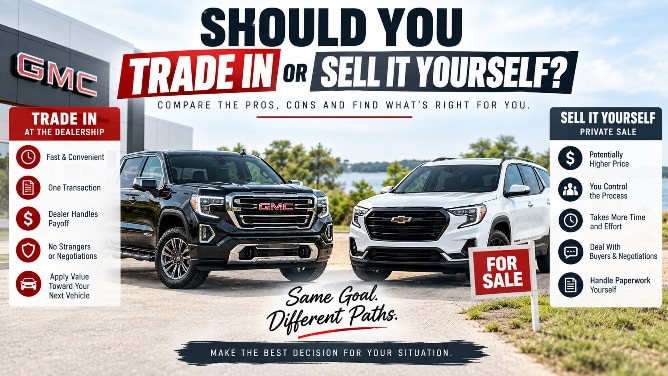
You're getting ready to buy another vehicle, but there's one question you need to answer first:
What should you do with the vehicle you already own?
For most people, there are two obvious choices.
You can trade it in at the dealership, or you can try to sell it yourself.
Selling privately may give you an opportunity to get more money for your vehicle. Trading it usually makes the process much easier.
So which option is better?
The answer depends on your vehicle, how much you owe, how quickly you want to sell it and how much time and effort you're willing to put into the process.
Let's look at both options so you can decide which makes the most sense for you.
Should You Trade In Your Car or Sell It Privately?
Here's the simplest way to look at it.
Consider selling privately if:
- Getting the highest possible selling price is your main priority
- You have time to advertise the vehicle
- You're comfortable meeting potential buyers
- You don't mind negotiating
- You're comfortable handling the paperwork
- You can wait for the right buyer
Consider trading your vehicle if:
- You value convenience
- You want to complete everything in one transaction
- You still have a loan on the vehicle
- You don't want to advertise it yourself
- You don't want strangers coming to your home or test-driving your vehicle
- You want to avoid handling the private-sale paperwork yourself
- You want to replace your vehicle quickly
Neither option is automatically right or wrong.
You're essentially deciding how much your time, convenience and potential additional selling price are worth to you.
Trade-In Value vs. Private-Sale Value
This is usually the first thing people think about.
Can I get more money if I sell my vehicle myself?
Potentially, yes.
A private buyer may pay more than a dealership offers as a trade because the dealership has additional costs and risks associated with purchasing the vehicle.
Depending on the vehicle, a dealership may need to:
- Inspect it
- Service it
- Replace tires or brakes
- Repair mechanical issues
- Repair cosmetic damage
- Detail it
- Market and advertise it
- Carry it in inventory until it sells
There's also no guarantee that every trade-in will be retailed by the dealership.
Some vehicles may ultimately be sold through a wholesale or auction channel instead.
A private buyer doesn't have those same business expenses.
That's one reason private-sale asking prices can sometimes be higher than trade-in values.
But there's another side to the equation.
An advertised private-sale price isn't necessarily what someone will actually pay.
You still have to find the buyer and complete the transaction.
Why Selling Your Car Yourself Can Make Sense
The biggest reason to consider a private sale is simple:
You may be able to get more money.
This can be especially appealing if:
- Your vehicle is in excellent condition
- It's a desirable model
- It has good service records
- You own it outright
- You're not in a hurry
- There's strong private-market demand for it
If the difference between your trade offer and realistic private-sale value is substantial, selling it yourself may be worth considering.
The key word is realistic.
Don't compare a dealership's actual purchase offer to the highest asking price you can find online.
Asking price and selling price are not always the same thing.
What Does Selling a Car Privately Actually Involve?
This is where the comparison gets more interesting.
Selling a vehicle yourself isn't just taking a few pictures and collecting money.
You may need to:
- Clean and prepare the vehicle
- Take good photographs
- Research an asking price
- Create advertisements
- Respond to calls, texts and messages
- Answer questions about the vehicle
- Deal with low offers
- Schedule appointments
- Meet strangers
- Allow test drives
- Negotiate the final price
- Verify payment
- Handle title and ownership paperwork
- Coordinate with a lender if there's an outstanding loan
You may sell the vehicle quickly.
Or you may spend several weeks answering messages before finding a serious buyer.
That's the tradeoff.
A higher potential selling price may require more of your time and effort.
Be Careful With Private-Sale Scams
Selling privately also means you're responsible for deciding whether a potential buyer and their payment are legitimate.
Be cautious with unusual payment arrangements, overpayment schemes, requests to ship a vehicle before funds are verified or buyers who want you to send money to a third party.
When possible, complete significant financial transactions in a secure environment and verify funds before transferring ownership.
You should also understand the title, registration and documentation requirements that apply to your transaction.
If you're unsure about a legal or title requirement, verify it with the appropriate state agency rather than relying on advice from the buyer.
Why Trading Your Vehicle Is Easier
The biggest advantage of trading is convenience.
Instead of completing two separate transactions, you're combining the sale of your current vehicle and the purchase of your next vehicle.
The dealership evaluates your vehicle, gives you a trade offer and applies the agreed value to the transaction.
If there's an existing loan, the payoff can usually be handled as part of the transaction as well.
You don't have to:
- Create an advertisement
- Take dozens of photos
- Answer marketplace messages
- Schedule meetings with strangers
- Allow unknown buyers to test-drive the vehicle
- Negotiate with multiple potential buyers
- Wait weeks hoping someone buys it
For many people, that's worth accepting a potentially lower amount than they might achieve through a successful private sale.
Trading Can Also Save Time Between Vehicles
There's another benefit that's easy to overlook.
If you sell your vehicle privately before buying the replacement, you may temporarily be without transportation.
If you buy the replacement first, you may temporarily own and insure two vehicles.
Trading allows the two transactions to happen together.
You arrive in your current vehicle and, once everything is completed, leave in your next one.
For someone who depends on their vehicle every day for work, school or family responsibilities, that simplicity can matter.
Can You Trade In a Car You Still Owe Money On?
Yes.
You do not have to completely pay off an auto loan before trading the vehicle.
The important numbers are:
- Your vehicle's trade value
- Your current loan payoff
Suppose your vehicle is worth $20,000 and your payoff is $15,000.
You would have approximately $5,000 in positive equity before considering the rest of the transaction.
That equity may be applied toward your next vehicle.
Trading a financed vehicle can also be simpler than a private sale because the dealership can work through the payoff process as part of the transaction.
What If You Owe More Than Your Car Is Worth?
If your loan payoff is higher than the vehicle's value, you have negative equity.
For example:
- Vehicle trade value: $18,000
- Loan payoff: $22,000
- Negative equity: approximately $4,000
That $4,000 doesn't disappear when you trade the vehicle.
Depending on the transaction and lender approval, you may need to pay some or all of the difference yourself, or some or all of it may be included in the financing on the replacement vehicle.
This is one reason knowing your trade value and payoff before shopping can be so helpful.
If you're trying to establish a vehicle budget, you may also want to read our guide How Much Should You Spend on a Used Car in 2026?
Can You Privately Sell a Car That Still Has a Loan?
It may be possible, but the process can be more complicated.
If a lender has a lien on the vehicle, you'll need to satisfy the lender's requirements before clear ownership can be transferred to the buyer.
The exact process can vary depending on the lender and where the vehicle is titled.
Before advertising a financed vehicle privately, contact your lender and find out:
- Your current payoff amount
- How the lender accepts payoff funds
- How the lien will be released
- How and when the title will become available
You don't want to figure this out after you've already agreed to sell the vehicle.
How Vehicle Condition Affects Your Decision
Condition can influence whether trading or selling privately makes more sense.
A very clean vehicle with strong service records and desirable equipment may be easier to sell privately.
On the other hand, imagine your vehicle has:
- Body damage
- Warning lights
- Worn tires
- Mechanical issues
- Very high mileage
- Interior damage
You now have another decision.
Do you spend money repairing those issues before selling it?
Or do you disclose the condition and sell it as-is?
A dealership can appraise the vehicle in its current condition and factor those issues into the offer.
That may be easier than repairing and preparing the vehicle for a private buyer.
What If Your Car or Truck Is Modified?
Aftermarket modifications don't always increase trade or resale value by the amount you spent on them.
A $3,000 modification doesn't automatically make the vehicle worth $3,000 more.
In some cases, modifications can actually reduce the number of potential buyers.
This is particularly relevant with modified trucks.
Lift kits, oversized wheels, suspension changes, exhaust systems, engine tuning and other modifications may appeal strongly to one buyer while discouraging another.
If you're considering selling privately because of modifications, research whether buyers in the market are actually paying a premium for vehicles equipped like yours.
Are There Tax Advantages to Trading In Your Vehicle?
There can be tax implications associated with trading a vehicle, but the rules depend on where the vehicle is purchased, titled and registered.
Because state tax laws vary, don't assume that a trade-in will automatically create a specific tax savings.
If the potential tax treatment is an important part of your decision, ask how the transaction will be taxed based on your specific situation before comparing a trade offer with a private-sale price.
The best comparison is your actual net financial result, not simply the two headline numbers.
Get a Trade Offer Before Deciding
You don't necessarily have to decide between trading and selling privately before knowing what your vehicle is worth.
Get an estimate first.
Once you know approximately what you could receive for your trade, you have something real to compare against the private market.
For example, suppose you believe you could privately sell your vehicle for $22,000 and receive a $20,500 trade offer.
Now you're not asking a theoretical question.
You're deciding whether the potential additional $1,500 is worth the time, advertising, appointments, negotiations, paperwork and other responsibilities involved with selling it yourself.
For one person, absolutely.
For another, absolutely not.
That's why we recommend getting the trade value before making the decision.
7 Questions to Ask Before Trading or Selling Privately
-
How quickly do I need to sell my vehicle?
-
Do I still owe money on it?
-
How much is my realistic private-sale value?
-
How much will a dealership actually offer me?
-
Am I comfortable meeting and negotiating with private buyers?
-
How much is my time worth?
-
How large is the real financial difference between the two options?
That last question may be the most important.
If the difference is several thousand dollars, you may decide a private sale is worth the effort.
If the difference is relatively small, trading may become much more attractive.
Don't Forget What Happens After You Sell It
If you're selling because you plan to purchase another vehicle, your decision shouldn't be made in isolation.
Consider the entire transaction.
How much will your replacement vehicle cost?
How much cash do you want to put down?
What will your financing look like?
How much equity do you have in your current vehicle?
Those numbers work together.
That's also why knowing your budget before shopping can save you a lot of frustration later.
Frequently Asked Questions About Trading In vs. Selling Privately
Do you usually get more money selling a car privately?
You may be able to sell a vehicle privately for more than its trade-in value because you're selling directly to the next owner. However, the actual difference depends on the vehicle, its condition, market demand and the price a buyer is ultimately willing to pay.
Why is trade-in value lower than private-sale value?
A dealership has expenses and risks associated with purchasing, inspecting, servicing, reconditioning, marketing and reselling a vehicle. Those costs are reflected in an appraisal.
Can I trade in a car I still owe money on?
Yes. The dealership can obtain the payoff information and account for the existing loan as part of the transaction.
Can I trade in a vehicle with negative equity?
Potentially. If you owe more than the vehicle is worth, the difference still needs to be addressed. Depending on the transaction and lender approval, you may need to pay the difference or some or all of it may be included in the new financing.
Should I repair my car before trading it?
Not automatically. Some repairs may cost more than the additional trade value they create. Consider getting the vehicle appraised in its current condition before spending significant money preparing it for trade.
Should I clean my car before getting it appraised?
A reasonably clean vehicle makes inspection easier, but you don't necessarily need to pay for an expensive professional detail before getting an appraisal.
Can I get my vehicle appraised even if I'm not ready to buy another car?
Yes. Knowing approximately what your vehicle is worth can be useful even if you're still researching your next purchase.
How do I find out what my trade is worth?
You can start online with the KBB Instant Cash Offer tool and provide information about your vehicle. The vehicle's actual condition and other factors will ultimately affect its value.
Thinking About Trading Your Vehicle in Elizabeth City?
If you're in Elizabeth City, Hertford, Edenton, Camden, Currituck, the Outer Banks, northeastern North Carolina or southeastern Virginia and you're trying to decide whether to trade your vehicle or sell it yourself, start by finding out what the vehicle is actually worth.
Once you have a real trade estimate, you can compare it with what you realistically believe the vehicle could sell for privately.
Then decide whether the potential difference is worth the additional time and work.
If you're also shopping for your next vehicle, you can browse our current used inventory and see what's available before making a decision.
Categories:
Used Car Buying Guides