

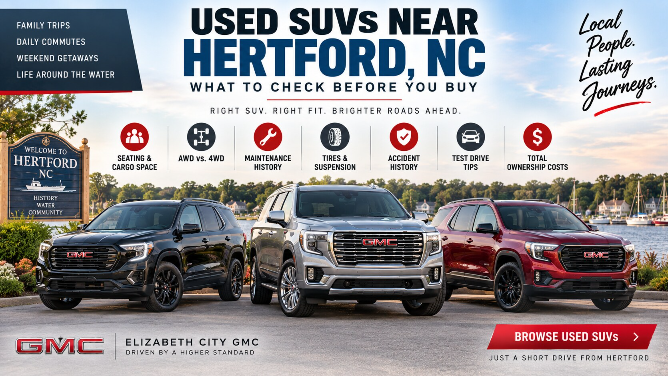
Shopping for a used SUV near Hertford, NC? Before you start comparing prices and mileage, think about what you actually need your next vehicle to do.
Maybe you need more room for your growing family. Maybe you're tired of squeezing luggage, sports equipment and groceries into a sedan. Or maybe you want something comfortable for your daily drive to Elizabeth City and weekend trips around northeastern North Carolina.
Whatever brought you to the SUV market, the goal is the same: find a vehicle that fits your life without taking on more expense than you need.
Here's what to check before buying a used SUV, along with a few things that are easy to overlook during a test drive.
1. Choose the Right SUV Size Before Comparing Models
One of the easiest mistakes to make is buying more SUV than you actually need.
A larger vehicle can be great for passengers and cargo, but it may also mean higher fuel costs, larger tires and a higher purchase price. On the other hand, choosing a smaller SUV just to save money can become frustrating if your family quickly outgrows it.
Compact SUVs
Compact SUVs are worth considering if you want a higher seating position and useful cargo space without moving into a large vehicle. They can be a practical fit for commuting, grocery runs and smaller families.
When comparing compact SUVs, pay attention to rear-seat legroom, car-seat access and how much space remains when the rear seats are occupied.
Midsize SUVs
A midsize SUV may offer a useful balance of passenger room, cargo space and everyday maneuverability. Some models offer a third row, although that doesn't necessarily mean the third row will be comfortable for adults or older children.
Don't judge a midsize SUV by its seating capacity alone. Sit in every row before deciding.
Full-Size SUVs
Full-size SUVs can make sense for larger families, frequent road trips, towing and buyers who regularly need both passenger seating and cargo space.
But a full-size SUV isn't automatically the right choice just because you have children. Think about parking, fuel costs, garage space and how often you'll actually use the additional room.
2. Check the Seating With Your Family in Mind
It's easy to look at an SUV online and assume it has plenty of room. The real test happens when everyone gets inside.
If you're shopping for a family vehicle, bring the people who will regularly ride in it. If you use child safety seats, bring those too.
Check the following:
- Can everyone get in and out comfortably?
- Is there enough legroom behind the driver's seat?
- Can you install your child safety seats correctly in the seating positions you plan to use?
- Can passengers reach the third row without a struggle?
- Is there enough cargo space when every seat is occupied?
- Can you fold the rear seats without removing equipment you use every day?
Pay special attention to cargo space behind the third row. Some SUVs advertise seating for seven or eight passengers but leave limited room for luggage when every seat is in use.
If your family regularly travels with sports bags, strollers, coolers or vacation luggage, that space matters.
3. Don't Assume You Need a Third Row
A third row sounds appealing, especially when you're shopping for a family SUV. But it isn't necessary for everyone.
Ask yourself how often you'll actually use it.
If you only need extra seating once or twice a year, a roomy two-row SUV may give you more useful cargo space for everyday driving.
If you're regularly transporting several children, their friends or extended family members, a three-row SUV may be worth the additional cost.
Also check how easy it is to access the third row. A vehicle that technically seats seven people may still be inconvenient if passengers have difficulty getting to the back.
4. AWD vs. 4WD: Which Do You Actually Need?
You'll see both all-wheel drive (AWD) and four-wheel drive (4WD) while shopping for used SUVs.
They aren't interchangeable terms, and neither is automatically necessary for every driver.
Front-Wheel Drive
A front-wheel-drive SUV may be perfectly suitable if most of your driving involves paved roads, commuting and normal family transportation.
It can also cost less to purchase and maintain than a comparable vehicle with a more complex drivetrain.
All-Wheel Drive
AWD can provide additional traction in certain slippery driving conditions. The way an AWD system operates varies by vehicle, so check the specific model rather than assuming every system works the same way.
Four-Wheel Drive
Some SUVs use 4WD systems designed for more demanding conditions. Their capabilities and operating requirements vary considerably.
If you're considering a vehicle for towing, unpaved roads or more challenging terrain, research its actual equipment and limitations.
For everyday driving around Hertford and Elizabeth City, don't pay extra for AWD or 4WD simply because it sounds like something an SUV should have. Decide whether your driving conditions justify it.
Remember that AWD and 4WD don't eliminate the need for good tires or careful driving.
5. Review the Maintenance History, Not Just the Mileage
Two used SUVs can have the same mileage and be in very different condition.
One may have received regular maintenance and spent most of its life on longer highway trips. Another may have missed services or experienced repeated mechanical problems.
That's why the odometer should be part of your evaluation, not the entire evaluation.
Ask about:
- Oil changes and routine maintenance
- Transmission and drivetrain service, when applicable
- Cooling-system maintenance
- Brake and tire replacement
- Previous repairs
- Outstanding recalls
- Any known mechanical or electrical issues
A vehicle-history report can provide useful information, but it isn't a guarantee that every accident, repair or maintenance event has been recorded.
If you're unsure about a vehicle's condition, consider an independent pre-purchase inspection by a qualified mechanic.
6. Inspect the SUV Carefully Before Buying
Don't let a clean interior or a fresh detail distract you from checking the vehicle itself.
Tires
Look at the tread depth, age and wear pattern of all four tires. Uneven wear may indicate an alignment or suspension issue that deserves further investigation.
Also check whether the tires are the correct size and type for the vehicle. Some AWD systems have specific tire-matching requirements.
Brakes and Suspension
Listen for unusual noises when braking or driving over bumps. Notice whether the vehicle pulls to one side or feels unstable.
Don't assume every noise is a major problem, but don't ignore it either.
Underbody and Rust
Inspect the underside for corrosion, damaged components and signs of previous repairs.
For vehicles that have spent time in coastal areas, look closely at exposed metal components. Surface rust and more serious structural corrosion are not the same thing.
Interior and Electronics
Test the features you'll use regularly:
- Air conditioning and heat
- Power windows and locks
- Backup camera
- Infotainment screen
- Bluetooth and phone connectivity
- Power liftgate, if equipped
- Heated or ventilated seats, if equipped
- Rear climate controls, if equipped
- Driver-assistance features, where safe and appropriate to test
Check for water stains, unusual odors and signs of moisture inside the cabin. If you notice anything concerning, ask for an explanation and have it inspected.
7. Take a Test Drive That Reflects Your Normal Driving
A quick trip around the parking lot won't tell you everything you need to know about an SUV.
Try to include the types of driving you'll actually do, when the route and conditions allow.
For someone living in Hertford, that might mean evaluating how the vehicle feels at normal road speeds, how comfortably it handles longer drives and how easy it is to maneuver into a parking space.
During the drive, pay attention to:
- Seat comfort and visibility
- Acceleration and transmission behavior
- Steering and braking
- Road and wind noise
- Ride quality over uneven pavement
- Blind spots
- Ease of parking
- Whether any warning lights appear
Afterward, spend a few minutes sitting in the parked vehicle. Adjust the seats, connect your phone and try the controls.
You'll be using those features long after the excitement of buying the SUV wears off.
8. Compare Safety Features by Vehicle, Not Just Model Name
Two SUVs from the same model year can have different safety and driver-assistance equipment depending on their trim levels and optional packages.
Features you may want to compare include:
- Automatic emergency braking
- Blind-zone monitoring
- Rear cross-traffic alerts
- Lane-keeping assistance
- Adaptive cruise control
- Surround-view cameras
- Parking assistance
Check the actual equipment on the specific SUV you're considering. Don't assume a feature is included because you saw it advertised on another vehicle of the same model.
Driver-assistance features have limitations and do not replace attentive driving.
9. Set a Budget That Includes More Than the Payment
Finding an SUV with an affordable monthly payment is important, but the payment is only one part of the cost.
Before buying, consider:
- Purchase price
- Interest rate and loan term, if financing
- Taxes and dealership fees
- Insurance
- Fuel
- Routine maintenance
- Expected tire and brake costs
- Potential repairs
A larger SUV may offer more room, but that extra space can come with higher ongoing expenses.
Also be cautious about stretching the loan term just to reach a particular payment. A lower monthly payment can mean paying more interest over the life of the loan.
Choose a vehicle you can comfortably afford to own, not just one you can get approved to buy.
10. Know What Your Current Vehicle Is Worth
If you're replacing a vehicle, its trade value may affect your budget for the next SUV.
Before shopping, find out approximately what your current vehicle is worth and, if you still have a loan, request an up-to-date payoff amount.
That will help you understand whether you have positive equity, negative equity or a vehicle you own outright.
You can start by getting a KBB Instant Cash Offer for your current vehicle.
Knowing those numbers early can make it easier to compare SUVs within a realistic budget.
Shopping for a Used SUV Near Hertford, NC?
You don't have to limit your search to vehicles located within Hertford itself.
Elizabeth City is a nearby option for Perquimans County shoppers who want to compare used SUVs in person. Elizabeth City GMC is located at 1197 Highway 17 South in Elizabeth City, approximately 17 miles by road from Hertford.
Our online used inventory lets you explore available vehicles before making the trip. Inventory changes, so check the current listings and confirm that a vehicle is available before heading over.
Whether you're comparing a compact SUV for commuting, a three-row family vehicle or something with additional towing capability, start with your actual needs and narrow the options from there.
Bring your car seats, measure the cargo area, ask questions and take the time to drive the vehicle.
The right used SUV isn't necessarily the largest, newest or most expensive one. It's the one that fits your passengers, your routine and your budget.
Frequently Asked Questions About Buying a Used SUV
What should I check first when buying a used SUV?
Start with the vehicle's size, seating and cargo space to make sure it meets your needs. Then review its maintenance history, condition, tires, drivetrain, safety equipment and total ownership costs.
Is a used SUV with 100,000 miles worth buying?
It can be. Maintenance history, mechanical condition, previous use and price all matter. A well-maintained higher-mileage SUV may be a better purchase than a lower-mileage vehicle with neglected maintenance. Consider a pre-purchase inspection.
Should I buy a two-row or three-row SUV?
Choose based on how many passengers you regularly carry and how much cargo space you need when those seats are occupied. A two-row SUV may offer plenty of room for a smaller household, while a third row can be useful for larger families.
Do I need AWD in a used SUV?
Not necessarily. AWD may provide additional traction in certain conditions, but a front-wheel-drive SUV may suit drivers who primarily travel on paved roads. Consider your actual driving needs, tire condition and the specific vehicle's capabilities.
Should I have a used SUV inspected before buying it?
An independent pre-purchase inspection is a useful way to identify potential mechanical or structural concerns, especially when maintenance records are incomplete or you have questions about the vehicle's condition.
Where can I shop for used SUVs near Hertford, NC?
You can browse available used SUVs at Elizabeth City GMC online and contact the dealership to confirm availability or arrange a test drive before visiting.
Find Your Next Used SUV Near Hertford
Ready to compare your options? Start with our current used inventory, narrow your search by the features you need and contact our team if you'd like to see a particular SUV in person.
Browse Used Cars, Trucks & SUVs
Find Out What Your Trade Is Worth
Elizabeth City GMC
1197 Highway 17 South
Elizabeth City, NC 27909
Categories:
Used Car Buying Guides