

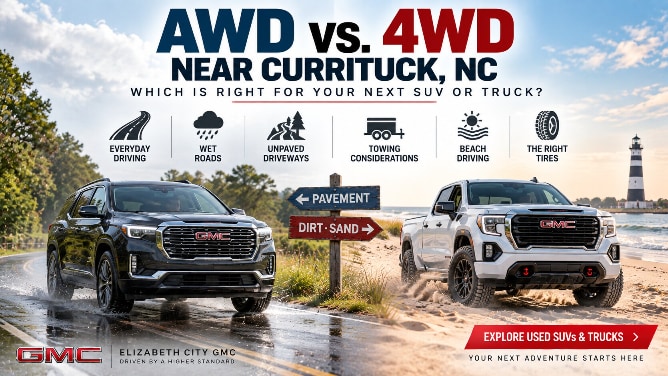
When you're shopping for an SUV or truck, it's easy to see “AWD” or “4WD” in a vehicle listing and assume they mean the same thing. Both can help a vehicle send power to more than two wheels, but they aren't identical, and neither is automatically necessary for every driver.
If you live near Currituck, NC, your next vehicle might need to handle daily commuting, rainy roads, an unpaved driveway, weekend trips or occasional towing. The right drivetrain depends on what you actually ask your vehicle to do.
Before paying extra for a particular system, it helps to understand the differences between AWD and 4WD, the limitations of each and the other features that matter just as much.
1. What's the Difference Between AWD and 4WD?
All-wheel drive (AWD) and four-wheel drive (4WD) are broad names for drivetrain systems that can deliver engine power to both the front and rear wheels. The way they operate varies by vehicle.
All-Wheel Drive (AWD)
AWD systems are commonly found in SUVs and crossovers. Many operate automatically, adjusting how power is distributed as driving conditions change. Some vehicles have selectable AWD modes, while others manage the system without much driver input.
AWD is often designed to provide additional traction during ordinary road driving, including on wet or slippery surfaces.
Four-Wheel Drive (4WD)
4WD is commonly found in pickup trucks and some SUVs. Many traditional truck systems allow the driver to select between two-wheel drive and four-wheel drive.
Depending on the vehicle, you may see settings such as 2HI, 4HI and 4LO. A low-range setting, when equipped, is intended for specific low-speed situations that require greater torque multiplication and control.
Not every 4WD system has the same settings or capabilities. Some offer an automatic four-wheel-drive mode, while others require the driver to select the appropriate setting manually.
The important takeaway: AWD and 4WD describe categories of systems, not a guarantee of how a particular vehicle will perform. Always check the features and operating instructions for the exact model you're considering.
2. When Does AWD Make Sense?
AWD may be worth considering if most of your driving happens on paved roads and you want a system that can provide additional traction when conditions change.
For example, you might prefer an AWD SUV if your typical routine includes commuting, school drop-offs, grocery runs and family trips, with occasional travel on wet roads or maintained unpaved surfaces.
Many AWD vehicles manage power distribution automatically, which can make the system convenient for everyday use.
However, AWD doesn't eliminate the possibility of losing traction. It also doesn't make a vehicle stop more quickly simply because power can reach four wheels.
Vehicle design, ground clearance, tire condition and driver behavior all matter.
3. When Does 4WD Make Sense?
A 4WD truck or SUV may be worth comparing if you regularly encounter conditions that call for more specialized traction capability.
Depending on the vehicle and its equipment, those conditions might include rough or uneven unpaved routes, certain low-speed off-road situations or work that takes you beyond maintained pavement.
Some 4WD vehicles offer low-range gearing and other off-road equipment that many AWD crossovers do not have.
That doesn't mean every 4WD vehicle is suitable for every trail or surface. Ground clearance, tires, vehicle weight, underbody protection and the driver's experience still affect what the vehicle can safely handle.
Also, certain part-time 4WD systems should not be used in locked four-wheel-drive modes on dry pavement. Doing so can place stress on drivetrain components. Follow the owner's manual for the specific vehicle.
4. AWD vs. 4WD for Everyday Driving Near Currituck
Instead of choosing based on the drivetrain badge alone, think about the roads and conditions you encounter most often.
| Driving situation | What to consider |
|---|---|
| Daily driving on paved roads | A two-wheel-drive vehicle may meet your needs. AWD or an appropriate automatic 4WD mode can offer additional traction in some conditions, depending on the vehicle. |
| Wet roads | AWD and some 4WD systems can help with traction when accelerating. Tire condition, appropriate speed and stopping distance remain critical. |
| Maintained gravel roads or driveways | Consider the surface condition, slope, tires and ground clearance. Many vehicles can handle well-maintained gravel without requiring a specialized drivetrain. |
| Rough or deeply rutted surfaces | Ground clearance, tire choice and vehicle-specific 4WD equipment may become more important. Check the vehicle's intended use and limitations. |
| Family trips and highway driving | Passenger comfort, cargo space, fuel costs and safety features may matter more than choosing AWD or 4WD alone. |
If your current vehicle already handles your usual routes comfortably, think about which situations you're trying to improve before deciding that your next one needs a different drivetrain.
5. What About Driving on the Beach?
For some shoppers near Currituck, beach access is part of the conversation when choosing a truck or SUV. But an AWD or 4WD badge alone does not mean a vehicle is suitable or permitted for driving on sand.
Soft sand presents different challenges from wet pavement or a maintained gravel road. Vehicle weight, ground clearance, tire type, tire pressure and drivetrain design can all affect performance.
Before planning to drive on any beach, check the rules for the specific access area, including vehicle requirements, permits, seasonal restrictions and current conditions. Requirements can differ by location and may change.
Review your vehicle owner's manual as well. Some AWD vehicles are not intended for deep sand or sustained off-road use, and certain 4WD vehicles may require specific settings or preparation.
Don't buy a vehicle solely because a listing says “AWD” or “4WD” if beach driving is one of your main goals. Verify that the exact vehicle is appropriate for the conditions and meets the rules where you intend to drive.
6. Why the Right Tires Matter Just as Much
A drivetrain can help deliver power to the wheels, but the tires are what connect the vehicle to the road.
Worn or inappropriate tires can limit traction even when a vehicle has AWD or 4WD.
When comparing vehicles, check:
- Tire tread depth and overall condition
- Whether all tires are the correct size and type for the vehicle
- Signs of uneven wear
- Whether the tires suit your usual driving conditions
- The manufacturer's requirements for tire replacement on that drivetrain
Some AWD systems have specific requirements concerning tire size and differences in tread depth. Replacing only one tire without checking those requirements can create problems on certain vehicles.
Ask about tire condition when shopping for a used SUV or truck, and consult the owner's manual before changing tire sizes or types.
7. Does 4WD Increase Towing Capacity?
Not necessarily. A 4WD badge does not automatically mean a truck can tow more than a comparable two-wheel-drive version.
Maximum towing capacity depends on the specific vehicle's configuration, including its engine, transmission, axle ratio, equipment and manufacturer ratings. Adding 4WD equipment can also affect vehicle weight and available payload.
If you plan to tow a boat, utility trailer or camper, start with the weight of the loaded trailer and the manufacturer ratings for the exact vehicle you're considering.
Check its towing capacity, payload rating, hitch equipment and applicable weight limits. Remember to account for passengers, cargo and trailer tongue weight.
For a used truck, don't rely on a generic towing number from an online listing. Verify the rating for that particular configuration before making a purchase.
8. What to Check When Buying a Used AWD or 4WD Vehicle
When you're considering a used vehicle, the condition of its drivetrain matters as much as the type of system it has.
Start by reviewing the available maintenance records and vehicle-history information. Then pay attention to how the vehicle drives and whether its drivetrain features operate as intended.
Check for Unusual Noises or Vibrations
Listen for grinding, clunking or humming noises during the test drive. Unusual vibrations or binding during turns can also be reasons to request a closer inspection.
Review the Tires
Look for uneven wear and check that the tires meet the manufacturer's specifications. Ask whether they have been replaced as a set when required for the vehicle.
Inspect the Undercarriage
Look for damage, fluid leaks and significant corrosion. If the vehicle may have been used on beaches or other harsh surfaces, ask about its previous use and maintenance.
Understand the Drivetrain Controls
If the vehicle has selectable 4WD modes, ask for a demonstration and review the owner's manual. Do not engage a mode on a surface where the manufacturer advises against using it.
Consider an Independent Inspection
A qualified mechanic can help identify drivetrain, suspension and other mechanical concerns that may not be obvious during a short test drive.
A vehicle-history report is useful, but it doesn't replace a physical inspection.
9. How to Choose Your Next SUV or Truck
Before narrowing your search to AWD or 4WD vehicles, write down what you need your next vehicle to do.
- Mostly paved-road driving? Compare comfort, efficiency, space and whether additional traction capability would be useful for your routine.
- Regular travel on rough surfaces? Look at ground clearance, tires and the exact vehicle's drivetrain equipment.
- Family transportation? Check seating, car-seat fit, cargo room and everyday convenience alongside drivetrain features.
- Work or towing? Verify payload, towing ratings and the equipment needed for your specific tasks.
- Beach driving? Confirm the vehicle's suitability and the requirements of the particular beach access area before buying.
Once you've identified your needs, compare individual vehicles rather than assuming every AWD SUV or 4WD truck will perform the same way.
Shopping Near Currituck, NC?
If you're comparing SUVs and trucks near Currituck, you can expand your search to Elizabeth City to explore additional options.
Browse the used inventory at Elizabeth City GMC to see available vehicles. Review each listing's equipment carefully, since drivetrain features and capabilities vary by model, year, trim and individual vehicle.
If a vehicle catches your eye, contact our team to confirm availability and arrange a test drive.
Frequently Asked Questions About AWD and 4WD
Is AWD the same as 4WD?
No. Both are broad categories of systems that can send power to the front and rear wheels, but their operation and intended uses vary. Many AWD systems manage power distribution automatically, while many traditional truck-based 4WD systems offer driver-selectable modes.
Is AWD or 4WD better for rain?
Both can help with traction in certain situations, particularly when accelerating. Neither prevents hydroplaning or guarantees shorter stopping distances. Appropriate tires, reduced speed and adequate following distance remain essential.
Do I need AWD for everyday driving in Currituck?
Not necessarily. Consider the surfaces you drive on, the conditions you encounter and how your current vehicle performs. A two-wheel-drive vehicle may be sufficient for your normal routine.
Can I use 4WD on dry pavement?
It depends on the system and selected mode. Some vehicles have modes designed for use on pavement, while locked modes on certain part-time 4WD systems should not be used on dry pavement. Follow the vehicle owner's manual.
Can an AWD SUV drive on the beach?
Do not assume that it can. Check the specific vehicle's capabilities and the rules for the beach access area. Some AWD vehicles are not designed for deep sand, and access requirements may exclude certain vehicles.
Does 4WD make a truck tow more?
Not automatically. Towing capacity depends on the exact vehicle configuration and manufacturer ratings. Compare the specific trucks you're considering rather than choosing based on drivetrain alone.
What should I inspect on a used AWD or 4WD vehicle?
Check maintenance history, tire condition, undercarriage condition, fluid leaks and unusual drivetrain noises. Review how the system operates and consider an independent pre-purchase inspection.
Explore Used SUVs and Trucks Near Currituck, NC
Whether you're considering an AWD SUV for family travel or a 4WD truck for work and recreation, start with the driving conditions and tasks that matter to you. Then compare the equipment, condition and cost of the individual vehicles that meet those needs.
Find Out What Your Trade Is Worth
Elizabeth City GMC
1197 Highway 17 South
Elizabeth City, NC 27909
Categories:
SUV & Truck Buying Guides